

Is selling 3d prints legal? This is the most critical question for makers in 2026. With the massive rise of high-speed desktop manufacturing, turning a hobby into a business has never been easier. However, many entrepreneurs fall into legal traps by assuming that a downloaded file equals a license to sell. Understanding whether selling 3d prints legal or not depends entirely on the intellectual property rights attached to the digital file.
In this extensive guide, we will dive deep into the legal landscape of 2026. We will cover Creative Commons licenses, commercial “Merchant” tiers, copyright law, and the bureaucratic requirements for running a legitimate 3D printing business. Whether you are on Etsy, Amazon, or your own Shopify store, this guide will ensure your venture remains profitable and protected.
1. The Core Question: When Is Selling 3D Prints Legal?
To determine if selling 3d prints legal for your specific case, we must distinguish between physical ownership and intellectual property ownership. When you buy or download an STL file, you own the data on your hard drive, but you do not own the design.
Copyright vs. Usage Rights
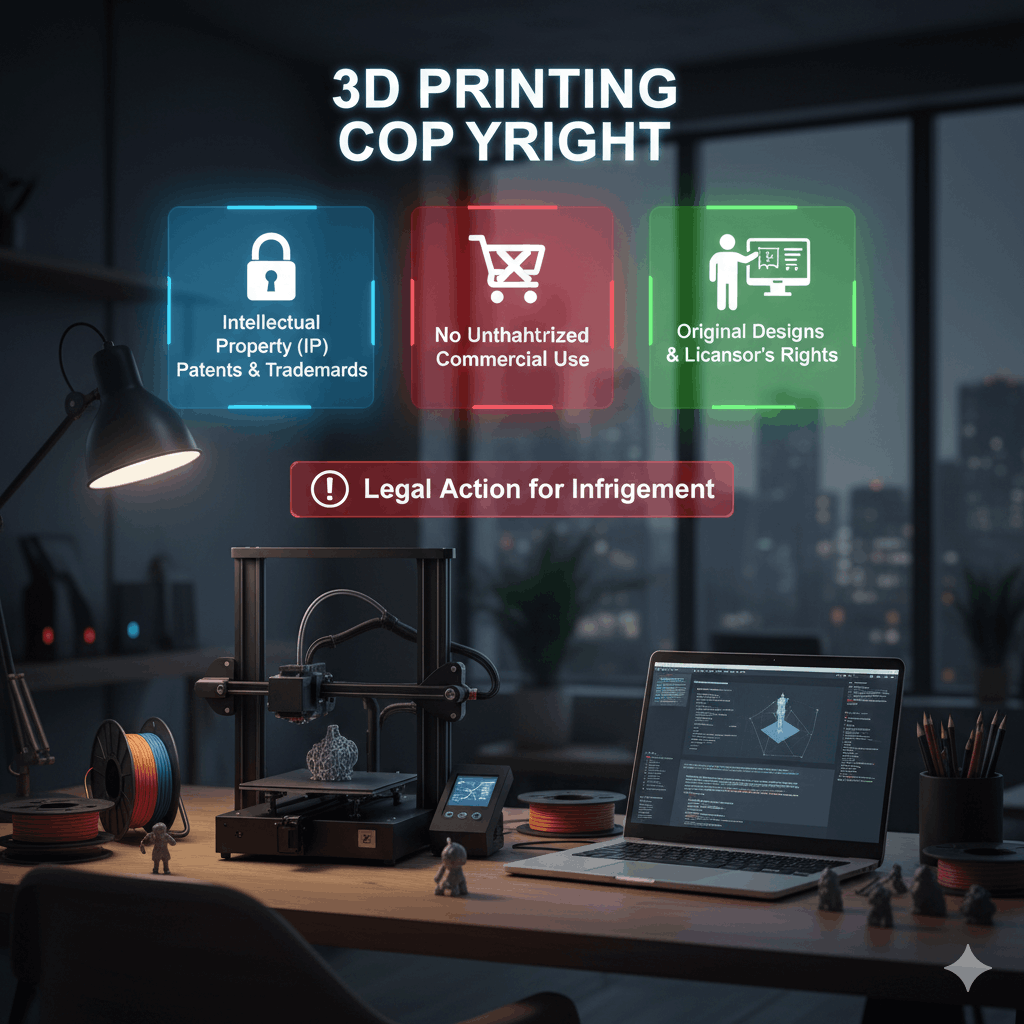
Every 3D model is a creative work protected by copyright law. The designer (creator) holds all exclusive rights to reproduce, modify, and sell that design. When a designer shares a file on platforms like Thingiverse, Printables, or Cults3D, they are granting you a Usage License. In the vast majority of cases, this license is restricted to personal use only. Making the act of selling 3d prints legal requires an explicit commercial grant from the copyright holder.
Trademark Infringement
Even if you have a commercial license for a generic design, you can still commit trademark infringement. For example, if you print a perfectly legal 3D-designed bracket for a car but market it using a protected brand name like “Tesla Accessory,” you are violating trademark laws. In 2026, brands use AI-driven crawlers to scan marketplaces for these exact violations.
2. Creative Commons Licenses: The Maker’s Legal Map
Most free STL files are shared under Creative Commons (CC) licenses. These licenses are the legal framework of the maker community. Understanding them is the first step in ensuring selling 3d prints legal for your shop.
CC BY (Attribution)
This is the most liberal license. You are allowed to sell the prints, provided you give appropriate credit to the designer. While it makes selling 3d prints legal, professional designers rarely use this for high-value models anymore.
CC BY-NC (Non-Commercial)
The “NC” stands for Non-Commercial. If you see this tag, the answer is a hard “No.” You cannot sell the print, nor can you sell the file. Even if you modify the model or paint it, the non-commercial restriction remains. Selling these items is a direct violation of international copyright law.
CC BY-ND (No Derivatives)
This allows for commercial sale (if the NC tag is missing) but prohibits any modification. You cannot rescale the model, add your logo, or change the geometry. You must print and sell it exactly as it was designed.
3. The Merchant Tier: The Gold Standard for Professional Sellers
In 2026, the most reliable way to make selling 3d prints legal is through the “Merchant Tier” subscription model. Platforms like Patreon and MyMiniFactory Tribes have revolutionized how designers monetize their work while allowing makers to build businesses.
How Merchant Subscriptions Work
You pay a monthly fee (typically between $15 and $50) to a specific designer (e.g., Cinderwing3D, STLFlix, or Hex3D). This fee grants you:
- The Commercial Right to Sell: You can legally sell physical prints of their designs as long as your subscription is active.
- Professional Marketing Assets: Access to high-quality renders and photos that increase your Click-Through Rate (CTR).
- Legal Protection: You receive a digital certificate or ID that you can provide to Etsy or Amazon to prove your right to sell.
Critical Note: Once you cancel your subscription, your right to sell usually expires. Some designers allow a “sell-off” period for existing stock, but you cannot print new items for sale.
4. Fan Art and the “IP” Trap: Disney, Marvel, and Nintendo
Many new sellers wonder if selling 3d prints legal when it comes to “Fan Art.” The reality in 2026 is that Fan Art is a legal minefield.
The Myth of “Fair Use”
Many people believe that if they “remix” a character or design it themselves from scratch, it falls under Fair Use. This is rarely true in a commercial context. If you sell a 3D-printed Pikachu, you are infringing on Nintendo’s trademark and copyright. Large corporations now use automated image-recognition bots that can shut down a store in seconds. One single infringement can lead to a lifetime ban from major selling platforms.
5. Global Regulations: Taxes, Safety, and Compliance
To make the business of selling 3d prints legal on a professional level, you must look beyond the STL license and comply with local laws.
Product Liability
As a seller, you are considered a manufacturer. If a 3D-printed toy breaks and a child swallows a small part, you are legally liable. In 2026, ensuring that your business of selling 3d prints legal includes having product liability insurance and, where necessary, CE or ASTM certifications for your products.
Packaging Laws
Many countries, particularly in Europe (e.g., Germany’s LUCID), require sellers to register and pay for the recycling of the packaging they send to customers. Ignoring these regulations can lead to heavy fines, even for small-scale hobbyists.
6. 2026 Business Strategy: Finding Profitable and Legal Niches
Instead of fighting over saturated and legally risky “Fan Art” niches, the most successful makers in 2026 focus on functional and original designs. This makes the process of selling 3d prints legal and much more sustainable.
- Functional Replacements: Designing parts for discontinued appliances or vintage cars.
- Original Desktop Organizers: Creating unique cable management systems or ergonomic desk accessories.
- Hydroponics and Gardening: Modular planters and watering systems for indoor gardening.
- Accessibility Tools: Printing specialized grips or tools for people with disabilities (often found under open-source licenses that allow sale).
7. Post-Processing and Value Addition
Value addition is another way to ensure selling 3d prints legal while increasing your margins.
- Custom Painting: A well-painted model can sell for 5x the price of a raw print.
- Assembly and Lighting: Integrating LEDs or electronics into 3D prints creates a “final product” rather than just a plastic part.
- Material Specialization: Using advanced filaments like Carbon Fiber, Wood-fill, or Glow-in-the-dark PETG to differentiate your shop.
8. FAQ: Common Legal Questions
Is selling 3d prints legal if I download them for free? Only if the license is CC BY or if the designer has explicitly stated that commercial use is allowed. Always check the “License” tab on the hosting site.
Can I sell prints if I bought the STL file? Not necessarily. Buying an STL for $10 on Cults3D usually only buys you a Personal License. You must look for a “Commercial License” or “Merchant License” option, which often costs more.
What happens if I get a Cease and Desist? Stop selling the item immediately. Most companies will not sue if you comply instantly. However, if you ignore the warning, they can take legal action that could bankrupt a small business.
Conclusion: Integrity is the Key to Success in 2026
In conclusion, selling 3d prints legal and profitable is a reality for thousands of makers worldwide, but it requires a professional approach. By respecting designers’ intellectual property, investing in merchant licenses, and focusing on original or functional products, you can build a business that lasts. 2026 is the year of the “Professional Maker”—be the one who respects the law and leads the market.