

Bambu Lab X2D vs. Creality K2 Plus: The Ultimate 2026 Flagship Comparison
The 3D printing landscape has officially entered its most competitive era. In 2026, the industry’s two titans have released their most ambitious machines to date: the Bambu Lab X2D and the Creality K2 Plus. This isn’t just a routine product launch; it is a fundamental shift in what we expect from a desktop workstation. While both machines promise to bring industrial-grade performance to your desk, their philosophies differ significantly. Whether you are an engineer requiring high-strength functional parts or a creator scaling up your production, this deep dive will help you choose the right champion.
1. Build Volume: The Battle of Scale
The first question any professional asks is: “How big can I print?” In this category, we see a clear distinction between compact precision and massive scale.
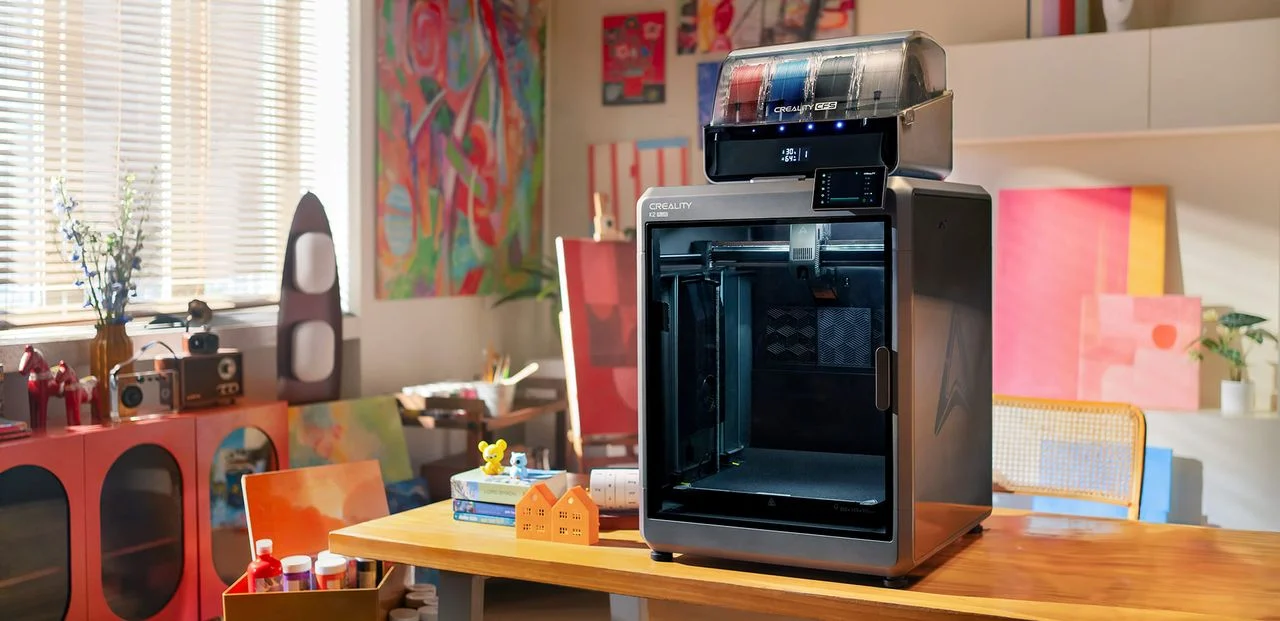
Creality K2 Plus remains the undisputed leader in size. With a generous 350 x 350 x 350 mm build volume, it is designed for those who refuse to split their models. If you are printing full-sized automotive prototypes, wearable cosplay armor, or large architectural layouts, the K2 Plus provides the creative freedom that smaller machines simply cannot match.
Bambu Lab X2D has evolved to a much-anticipated 300 x 300 x 300 mm envelope. While it doesn’t reach the K2 Plus’s raw volume, it represents a massive leap from the previous 256mm standard. Bambu Lab focuses on the “ideal equilibrium”—large enough for 90% of industrial use cases while maintaining a footprint that fits perfectly on an office desk without needing a dedicated workshop bench.
2. Motion System: Engineering for 800 mm/s
Both printers boast incredible speeds, but the engineering behind those movements determines whether your final print looks like a prototype or a finished product.
- Bambu Lab X2D (800 mm/s): The X2D operates with the precision of a surgical instrument. It utilizes a new Titanium-Carbon Hybrid motion system. By reinforcing ultra-light carbon fiber rods with a titanium internal honeycomb structure, Bambu has eliminated the “flex” that typically occurs at 35,000 mm/s² acceleration. The result? Flawless vertical walls even at speeds that challenge the laws of physics.
- Creality K2 Plus (600 mm/s): Creality has opted for a “tank-like” robust build. Utilizing heavy-duty all-metal linear rails on all axes, the K2 Plus prioritizes structural stability and long-term durability. While its top speed is slightly lower than the X2D, it manages the momentum of its larger print head with impressive grace, ensuring dimensional accuracy even on massive, heavy prints.
3. Thermal Control: The Secret to Industrial Materials
If you plan to move beyond PLA and PETG into high-performance polymers, ambient heat is your most critical variable.
The Bambu Lab X2D is a category-killer here with its 90°C Active Chamber Heater. This system doesn’t just heat the bed; it controls the entire internal atmosphere. This allows you to print aerospace-grade materials like PEEK and Ultem—materials usually reserved for $50k industrial machines—with zero warping and perfect layer adhesion.
The Creality K2 Plus features an Active 60°C Chamber. This temperature is ideal for high-quality ABS, ASA, and Polycarbonate (PC) prints. It effectively reduces internal stresses in large plastic parts, preventing corner lift. While it may struggle with exotic materials like PEEK, it is more than sufficient for the vast majority of professional engineering and functional prototyping projects.
| Core Specifications | Bambu Lab X2D | Creality K2 Plus |
|---|---|---|
| Max Print Speed | 800 mm/s | 600 mm/s |
| Chamber Heating | Active 90°C | Active 60°C |
| Kinematics | Hybrid Titanium/Carbon | All-Metal Linear Rails |
| Build Volume | 300 x 300 x 300 mm | 350 x 350 x 350 mm |
In Part 1, we’ve established that the Creality K2 Plus is the king of scale, while the Bambu Lab X2D is the master of high-temp precision. But hardware is only half the battle. In the next part, we will analyze their AI “Brains” and the multi-material systems that make these machines truly autonomous.
4. The AI Showdown: Which Machine is Smarter?
In 2026, a high-end 3D printer must do more than just move; it must “perceive.” The real rivalry between the Bambu Lab X2D and the Creality K2 Plus is defined by the power of their sensors and the autonomy of their software.
Bambu Lab X2D: Neural LiDAR 2.0 Technology
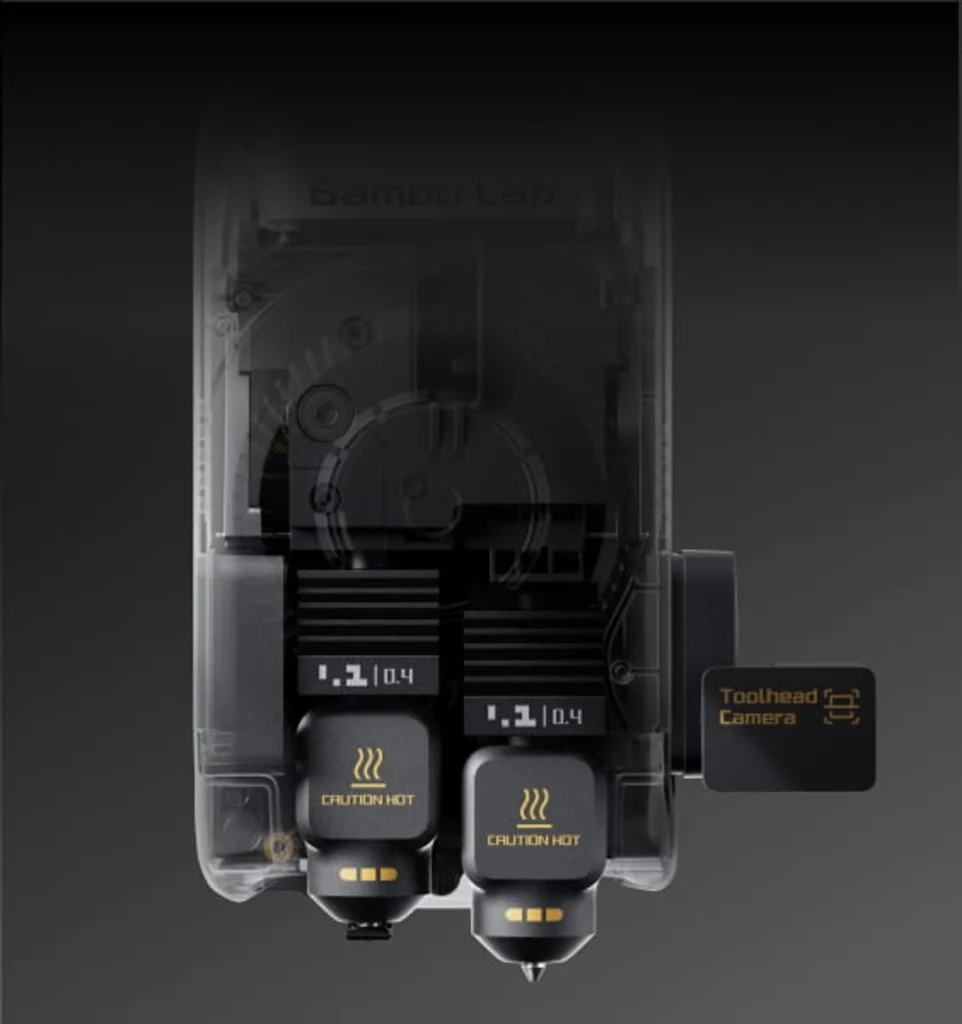
Bambu Lab continues to push the boundaries of smart printing. The new Neural LiDAR 2.0 analyzes over 2 million data points per second to monitor the molten plastic flow in real-time. If the AI detects microscopic air bubbles or slight inconsistencies in the filament, it instantly adjusts the extrusion pressure. This “invisible hand” is what allows the X2D to maintain a staggering 0.005mm precision even at 800 mm/s, ensuring that speed never comes at the cost of accuracy.
Creality K2 Plus: Dual AI Camera System
Creality has opted for a massive visual surveillance approach. The K2 Plus is equipped with two high-definition AI cameras: one dedicated to detecting surface errors (spaghetti detection) and another focused exclusively on flow calibration. While it may not offer the same “surgical” micro-adjustments as Bambu’s LiDAR, Creality’s system is exceptionally reliable for large-scale prints where global visual monitoring is paramount to prevent catastrophic failures.
5. AMS 2.0 vs. CFS: The Color War
Multi-material printing is no longer a luxury; it’s a professional requirement. Here is how these two giants manage your filament library:
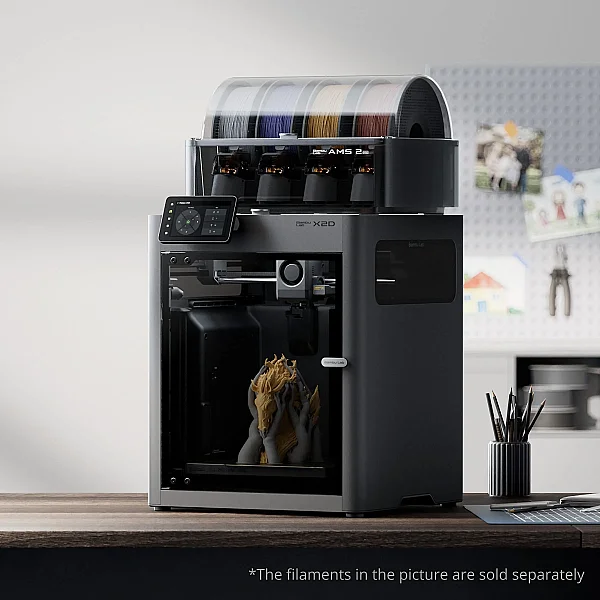
- Bambu Lab AMS 2.0 (Active Drying): The greatest strength of the AMS 2.0 is its integrated active drying unit. It doesn’t just switch colors; it actively pre-heats and dehumidifies the filament before it ever reaches the nozzle. For hygroscopic materials like Nylon (PA) or water-soluble supports (PVA), this is a revolutionary feature that guarantees crisp prints without any stringing.
- Creality CFS (Smart Filament System): The CFS system by Creality prioritizes versatility. It accepts a much wider range of third-party filament spool sizes without the need for printed adapters. Furthermore, Creality’s open RFID chip architecture allows third-party filament manufacturers to offer automatic settings, giving the user much more freedom in material choice.
6. Software and User Experience: Apple-Like Fluidity vs. Klipper Freedom
Bambu Studio remains the gold standard for workflow efficiency. The integration between the slicer, the mobile app, and the printer is so seamless that it feels like using an Apple product. For professionals who want “plug-and-play” perfection without getting lost in settings, this ecosystem is invaluable.
Creality Print 5.0 has made massive strides. Built on an optimized open-source architecture, it offers much more “tinkering” potential for expert users. If you enjoy fine-tuning every single parameter and pushing the limits of your machine via Klipper-based controls, the Creality K2 Plus offers a level of technical freedom that Bambu’s more closed ecosystem does not always allow.
Technical Verdict: The Bambu Lab X2D is the ultimate precision instrument for those who want perfect results with zero friction. The Creality K2 Plus is the robust production powerhouse for those who need maximum volume and modification flexibility.