

Bambu Lab X2D Review: A New Era in 3D Printing (Part 1)
The landscape of desktop 3D printing has evolved at a breakneck pace over the last five years, but perhaps no brand has disrupted the industry as aggressively as Bambu Lab. While the X1 Carbon set the gold standard for speed and “out-of-the-box” reliability, the year 2026 demands more from a flagship machine. Enter the Bambu Lab X2D. This is not merely an incremental speed bump; it is a hybrid revolution that brings industrial-grade capabilities—specifically active thermal management—to the desktop prosumer. In this comprehensive review, we will dissect the hardware architecture of the X2D and explain why it is being hailed as a true “game changer” for the manufacturing world.
1. The Bambu Lab X2D: Shifting the Desktop Paradigm
When the original X1 series launched, it perfected the “plug and play” philosophy, liberating users from the tedious rituals of manual leveling and constant calibration. However, professional engineers and advanced makers still faced a significant bottleneck: the lack of true active thermal control. Printing high-performance engineering plastics like PEEK, Ultem, or carbon-fiber-reinforced Nylon (PA-CF) remained a challenge in passive enclosures. The X2D was engineered to bridge this gap, redesigning nearly every internal component to transform a desktop hobbyist tool into a professional production station.
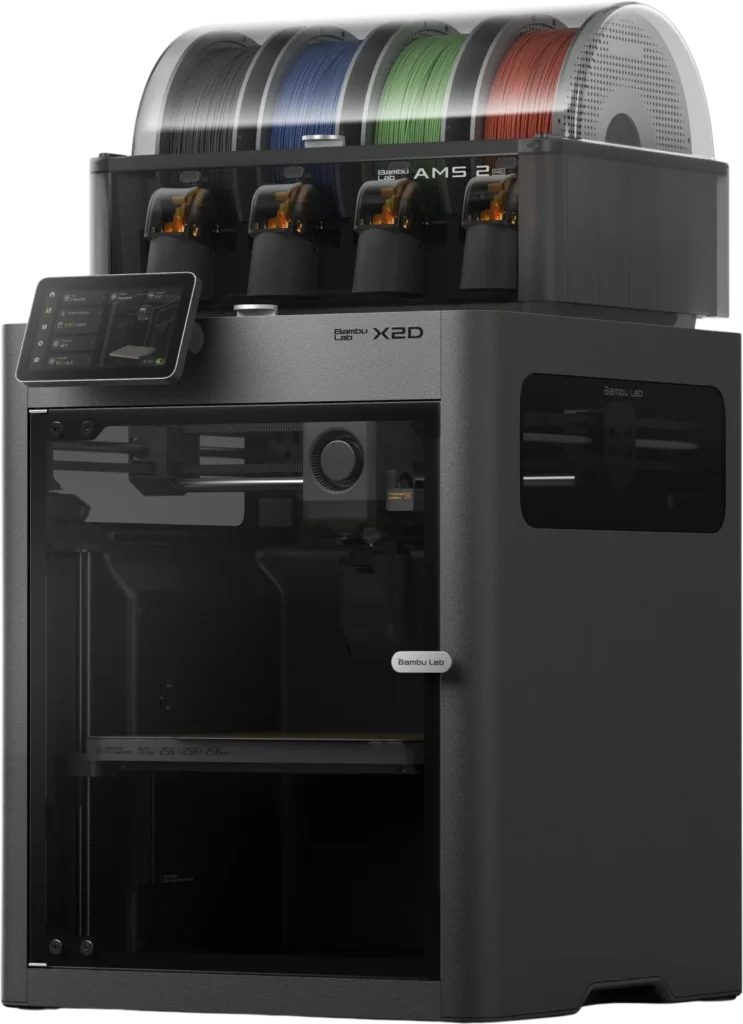
From the outside, the X2D retains the sleek, minimalist aesthetic that the community has come to love, but beneath the aluminum frame lies a completely different beast. The X2D’s core value proposition is “Industrial Quality at Desktop Speed.” This capability is mission-critical for industries ranging from automotive prototyping to aerospace components and medical modeling, where material strength is as vital as dimensional accuracy.
Comprehensive Hardware Comparison: X1C vs. X2D
To appreciate the leap in technology, we must look at the data. The X2D outclasses its predecessor in every measurable technical vertical:
| Feature | X1 Carbon (Legacy) | X2D (Next-Gen) | Performance Impact |
|---|---|---|---|
| Max Print Speed | 500 mm/s | 800 mm/s | 60% faster throughput |
| Acceleration | 20,000 mm/s² | 35,000 mm/s² | Ultra-sharp corners |
| Chamber Heating | Passive (Max 60°C) | Active (90°C Constant) | Zero warping on ABS/PC |
| Processing Power | Quad-Core SoC | Octa-Core AI Neural Engine | Real-time error correction |
| Motion System | Standard Carbon Rods | Titanium-Core Carbon Hybrid | Zero vibration at high speeds |
2. Motion Mechanics: Mastering Precision at 800 mm/s
Achieving 800 mm/s is not a simple matter of cranking up the motor voltage. At these velocities, physical laws dictate massive vibration and momentum challenges. Bambu Lab engineers addressed these barriers with three radical innovations in the X2D:
- Titanium-Reinforced Carbon Rods: While carbon fiber rods are lightweight, they can experience micro-flexing under extreme acceleration. The X2D introduces rods with a honeycomb titanium internal structure. This increases rigidity by 40% without adding significant mass, effectively eliminating the “ringing” or “ghosting” effects commonly seen in high-speed prints.
- Brushless Motor Technology: Moving away from traditional stepper motors, the X2D utilizes high-torque brushless motors. These are significantly quieter, more efficient, and virtually eliminate the risk of “skipped steps.” They also allow for a silent operation mode that stays under 45 dB, making it suitable for office environments.
- Active Vibration Compensation 2.0: This software-driven algorithm predicts the resonance frequency of the print head milliseconds before a move. It then sends a counter-vibration command to the motors, neutralizing mechanical jitter in real-time. The result is a glass-like surface finish even at record-breaking speeds.
3. Active Heated Chamber: The Cure for Warping
If you have ever printed with ABS or ASA, you have likely struggled with “warping”—where the corners of the part lift off the bed due to thermal contraction. The X2D features a 300W independent ceramic heating unit that maintains a steady 90°C environment inside the build volume.
Why is 90°C the Magic Number?
Most technical filaments need to be printed near their Glass Transition Temperature (Tg) to reduce internal stress. The active chamber ensures that the part cools uniformly only after the print is finished. This doesn’t just prevent warping; it dramatically improves layer adhesion, increasing the mechanical strength of the Z-axis by up to 35% compared to open-air or passive-chamber printers.
Engineering Note: Parts printed in the X2D’s heated chamber exhibit mechanical properties that are nearly indistinguishable from injection-molded parts. This elevates the X2D from a prototyping tool to a low-volume manufacturing powerhouse.
4. Quick-Swap Hotend 2.0: Efficiency Reimagined
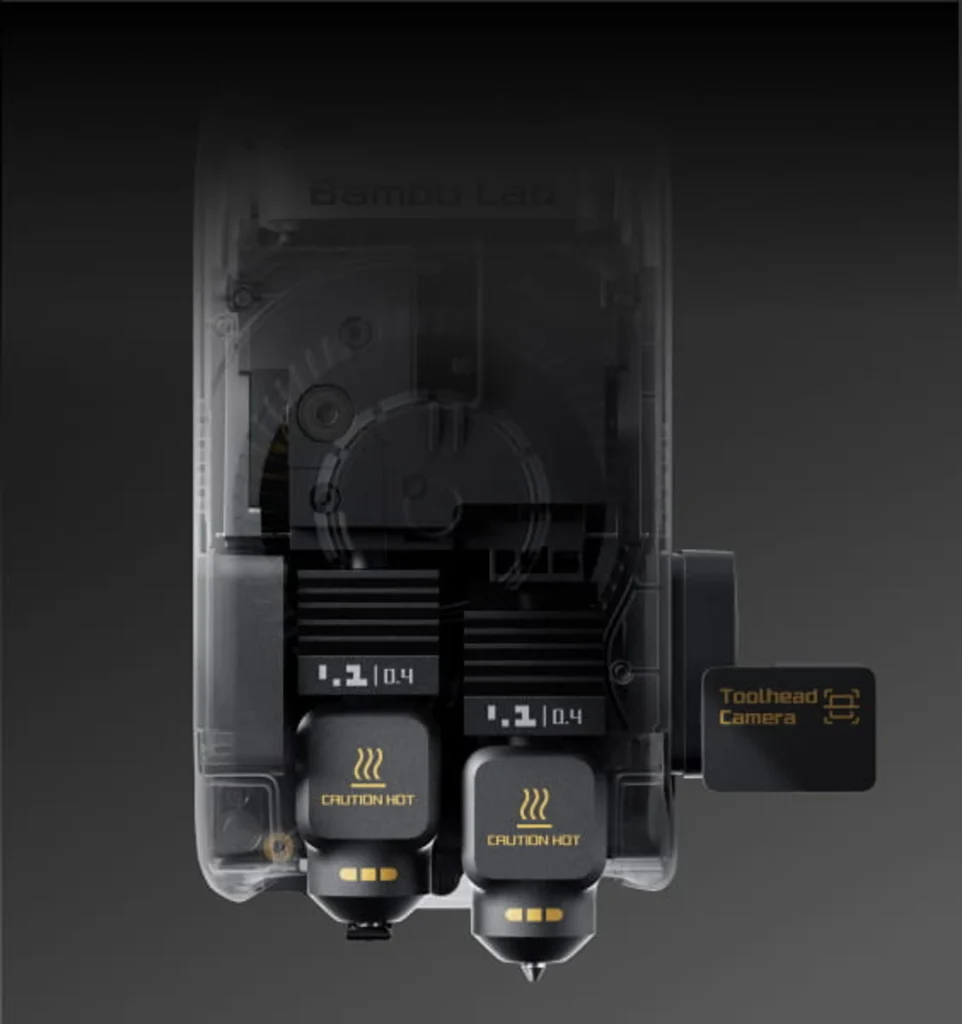
Bambu Lab has turned nozzle changes into a “ten-second task.” The X2D utilizes a new magnetic, pin-based socket system. There are no wires to unplug, no thermistors to delicate handle, and no thermal paste required. Whether switching from a 0.2mm detail nozzle to a 0.8mm high-flow hardened steel nozzle, the process is tool-less and instantaneous.
Bambu Lab X2D Review: Artificial Intelligence and Multi-Material Mastery (Part 2)
If the mechanical frame represents the body of a 3D printer, then the software and AI are its brain. The Bambu Lab X2D takes the concept of a “smart printer” to the next level with its integrated Octa-Core AI Neural Engine. This allows the machine to make real-time decisions, transforming it from a passive tool into an active manufacturing assistant. In this section, we explore the groundbreaking Neural LiDAR 2.0, the refined AMS 2.0, and the seamless software integration that defines the X2D experience.
5. Neural LiDAR 2.0: The Digital Eye for Micron-Precision
While the X1 series introduced us to LiDAR technology, the X2D elevates this with Neural LiDAR 2.0. This is not just a sensor upgrade; it is a fundamental shift in how the printer perceives its environment. Utilizing a dual-laser scanner capable of analyzing 2 million data points per second, the X2D provides a level of scrutiny previously reserved for industrial metrology equipment.
- Real-Time Flow Dynamics: Every filament, even within the same brand, has slightly different viscosity and flow characteristics. The X2D doesn’t just calibrate flow at the start; it monitors it continuously during the print. If the system detects a micron-level deviation in extrusion, the AI adjusts motor torque and speed instantly to maintain perfect wall thickness.
- Dynamic First Layer Inspection: The first layer is the foundation of any successful print. Neural LiDAR 2.0 scans the entire build plate in seconds, creating a high-resolution topographical map. If the AI detects a smudge, a piece of debris, or a non-adhered region, it pauses the print and sends a high-definition photo to your smartphone, saving you from a potential “spaghetti” disaster.
- Automated Z-Offset Calibration: Manual bed leveling is officially a relic of the past. The LiDAR measures the distance between the nozzle tip and the build plate with a precision of 0.005mm, ensuring a perfect “squish” on every single print, regardless of the plate type used.
6. AMS 2.0: Efficiency and Ecology in Multi-Color Printing
The Automatic Material System (AMS) made multi-color printing accessible, but it wasn’t without its flaws—namely filament waste (poop) and slow transition times. AMS 2.0 addresses these pain points with sophisticated engineering solutions that make multi-material printing more economical and environmentally friendly.
Key Innovations in AMS 2.0
- Active Filament Conditioning: The new AMS is no longer a passive dry box. It features an integrated 50W heating element that maintains an internal temperature of 45-55°C. This ensures that hygroscopic materials like Nylon (PA), TPU, and PVA (support filament) remain bone-dry during the entire printing process, preventing stringing and structural weakness.
- Turbo Transition Mechanism: By optimizing the filament cutter and the retraction path, Bambu Lab has reduced material swap times by 35%. On a model with thousands of color changes, this adds up to hours of saved time and significantly less wear on the mechanical components.
- Zero-Waste Buffer Technology: The X2D’s software now utilizes a “Purge-to-Infill” algorithm that is 40% more efficient. By using the transition material to fill the internal structure of the model, the amount of discarded “poop” is drastically reduced, making multi-color projects much more cost-effective.
7. 8K AI Vision Camera: Advanced Monitoring and Content Creation
The Bambu Lab X2D isn’t just for making parts; it’s for sharing the process. The built-in 8K Ultra-HD Camera provides the crispest visual feedback in the industry, but its primary role is functional. Using High Dynamic Range (HDR) sensors, it can “see” in low-light conditions better than any previous model.
- Spaghetti Detection 2.0: The AI engine analyzes the video feed at 30 frames per second. It is trained on millions of failed print images to recognize catastrophic failures (like a part detaching from the bed) 10x faster than traditional camera-based systems.
- Pro-Grade Timelapses: The AI automatically syncs the toolhead position at the end of each layer, creating “smooth” timelapses where the model appears to grow magically out of the plate. At 8K resolution, these are ready for professional social media use without further editing.

8. Software Synergy: Bambu Studio 2.0
The X2D’s hardware is unlocked via Bambu Studio, which now features a “Cloud-Based Material Library.” Once your printer identifies a filament via RFID, the slicer automatically fetches the most successful community-vetted settings (temperature, cooling, speed) for that specific material on an X2D. It turns 3D printing into a “one-click” experience similar to a standard paper printer.
User Experience Note: The synergy between the X2D hardware and the Bambu Handy app makes remote management a breeze. You can slice, print, and monitor your “mini-factory” from anywhere in the world with total confidence.