

Bambu Lab P2S Review: A New Era in 3D Printing?
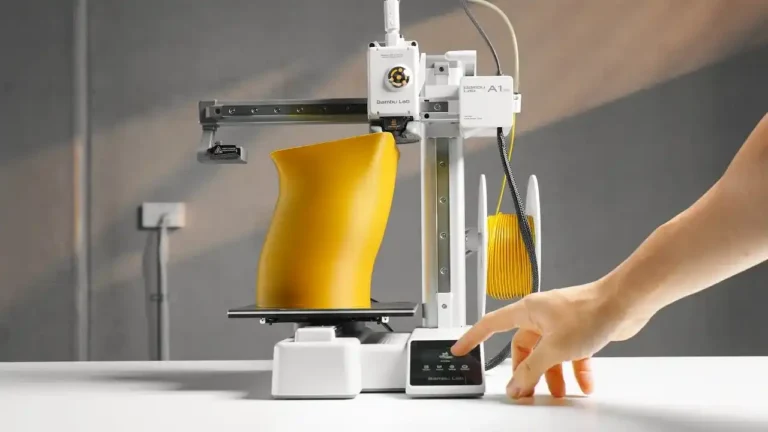
The 3D printing world continues to be shaken by every new model Bambu Lab releases. However, the Bambu Lab P2S, announced in 2026, has not just raised the bar—it has rewritten the rules of the game. This new member of the P-series inherits the success of its predecessor, the P1S, while bringing industrial speeds to the home user’s desk.
1. At a Glance: What is the P2S?
The Bambu Lab P2S is designed as a perfect blend of speed, reliability, and a user-friendly interface. The “S” (Secret/Special) suffix signifies that the device has a fully enclosed chassis, making it ready to print engineering-grade materials. But what makes the P2S special is the completely revamped motion control system inside.
2. Why is it the Most Anticipated Printer of 2026?
Users no longer just want a machine that “prints”; they want a machine that “doesn’t cause problems.” The Bambu Lab P2S directly meets this need with its out-of-the-box, calibration-free structure and AI-supported error detection system.
3. Design and Build Quality
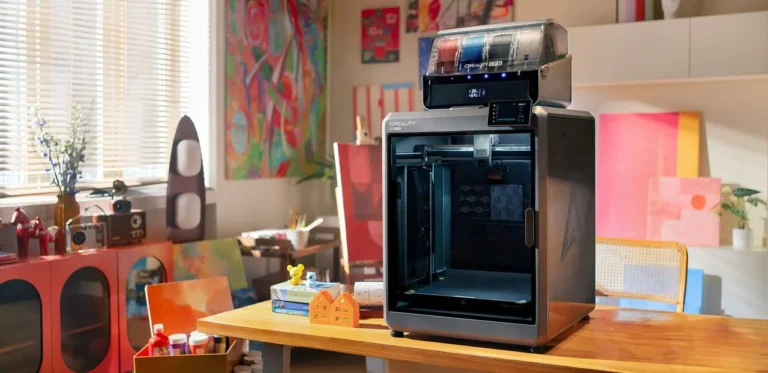
With its modern and compact design, the P2S fits into any workspace. Its transparent glass panels and internal lighting make monitoring the printing process a pleasure, while its improved insulation minimizes odors and heat loss when printing materials like ABS and ASA.
Part 2: Technical Specifications and Performance: Power Beyond Speed
Evaluating a 3D printer solely by its speed would be a mistake; what truly matters is the print quality it delivers at that speed. The Bambu Lab P2S shatters the “print fast but print ugly” myth with hardware that pushes the boundaries of 2026 technology.
1. Unshakable Speed: 600 mm/s and Beyond
The P2S takes the CoreXY architecture it inherited from its predecessors a step further.
- Acceleration: Reaching an acceleration value of 20,000 mm/s², the printer maintains its velocity even in the tightest curves.
- Active Vibration Compensation: Before every print, the printer calibrates itself to calculate motor vibrations and neutralizes them during printing. This results in smooth surfaces even at high speeds.
2. Revamped Extruder System
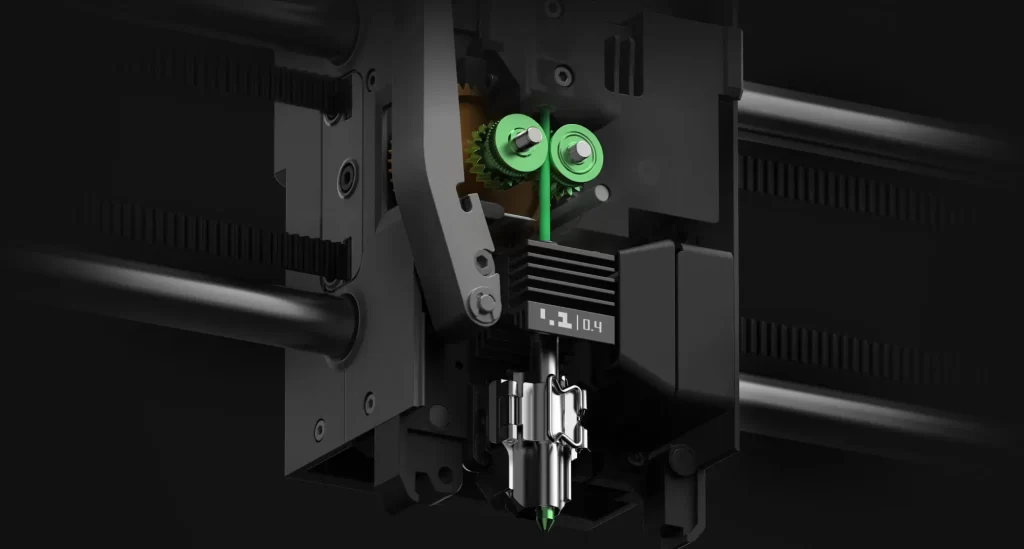
The Bambu Lab P2S comes with a completely metal, high-flow hotend.
- 300°C Maximum Temperature: This temperature allows technical materials like carbon fiber-reinforced nylon to flow like butter.
- Anti-Clog Technology: The redesigned gear structure makes filament slipping or jamming nearly impossible.
3. Intelligent Cooling and Silence
High speed requires high cooling. The P2S ensures layers solidify instantly thanks to its improved side fan and closed-case air circulation. Additionally, with the “Silent Mode” feature, it produces 30% less noise than the previous generation while operating at 600 mm/s.
🔍 Technical Specifications Summary
| Feature | Bambu Lab P2S Value |
| Max Print Speed | 600 mm/s |
| Max Acceleration | 20,000 mm/s² |
| Nozzle Temp | 300°C |
| Build Plate Temp | 120°C (High Efficiency) |
Part 3: AMS 2 Pro and Multi-Color Printing: Bring Your Imagination to Life
In 2026, the ability to use multiple colors in a single 3D print is no longer a luxury—it’s the new standard for creativity. The Bambu Lab P2S, paired with the new AMS 2 Pro (Automatic Material System), doesn’t just make multi-color printing easier; it elevates it to a professional level.
1. AMS 2 Pro: Smart and Self-Drying System
The next-generation AMS 2 Pro that accompanies the P2S is significantly smarter than its predecessors.
- Active Drying Feature: This is the biggest innovation of 2026! The AMS 2 Pro is no longer just a storage box; it actively heats filaments up to 65°C. This ensures that moisture-sensitive materials like PETG or Nylon remain fresh at all times.
- RFID Recognition: When you load Bambu Lab filaments, the system automatically detects the color and material type. All you have to do is hit “Print.”
2. Scalable Capacity: Up to 20 Colors
A single AMS 2 Pro unit holds 4 different spools. However, thanks to the advanced control board of the P2S, you can daisy-chain up to 4 AMS 2 Pro and 4 AMS HT units, allowing for prints with up to 20 different colors. This offers unlimited freedom, especially for complex figurines and architectural models.
3. Waste Management and Efficiency
The biggest issue in multi-color printing has always been “poop”—the filament waste. The Bambu Lab P2S utilizes optimized transition algorithms and new “prime tower” settings to reduce filament waste by 20% compared to previous generations. Additionally, the auto-refill feature ensures your prints never fail if a spool runs out.
🎨 Multi-Color Advantages
- No Post-Painting Needed: Your part is ready to use immediately after printing.
- Support Material Integration: Use a dedicated channel for “Support” filament to create easy-to-remove supports that leave no marks on your model.
- Smart Humidity Control: Electromagnetic valves maintain an airtight seal inside the AMS.
Part 4: AI and Smart Sensors: Your Printer is Watching You!
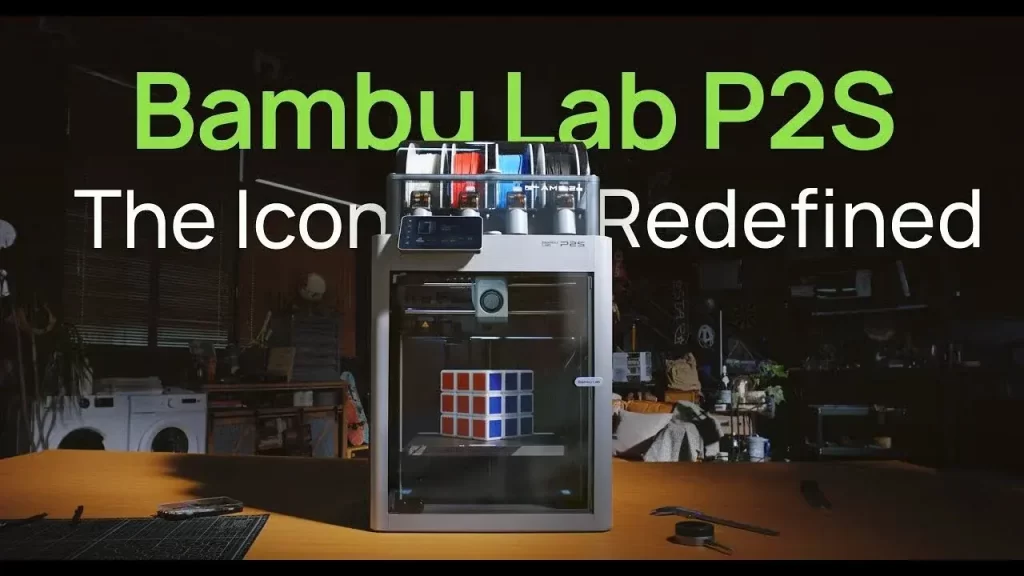
The Bambu Lab P2S is not just a fast machine; it is an intelligent assistant that notices your mistakes for you. In 2026, the dreaded “spaghetti failures” and forgotten objects on the build plate are a thing of the past, thanks to the P2S’s advanced NPU (Neural Processing Unit) and its 1080p camera.
1. The New 5-Inch Touchscreen
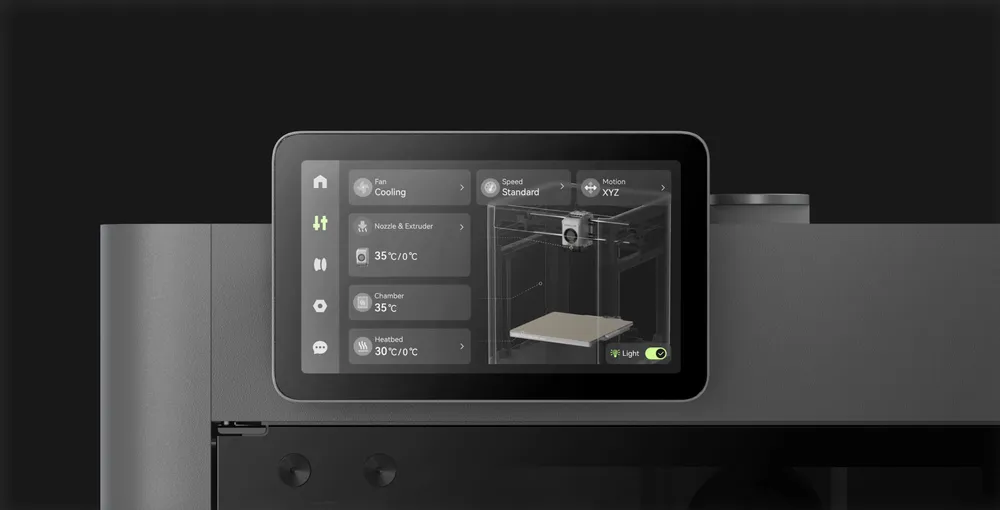
One of the most significant upgrades from the P1S is the 5-inch, full-color touchscreen on the front panel.
- Fluid Interface: The 2026 model UI (User Interface) offers responsiveness on par with a modern smartphone. Monitoring filament status, starting a calibration, or checking print history has never been easier.
- Live Monitoring: Even when you’re standing right by the printer, you can watch the 1080p live feed on the large screen to see the finest details of your print.
2. AI Failure Detection System
The camera inside the P2S does more than just record video; it analyzes every layer in milliseconds:
- Spaghetti Detection: If a print detaches from the bed and turns into a mess of plastic strings, the AI detects this instantly, pauses the print, and sends a notification to your phone.
- First Layer Inspection: The most critical moment of any print is the first layer. If there is a bed adhesion issue or an irregularity, the P2S warns you immediately, preventing a 10-hour print from being wasted at the start.
- Foreign Object Detection: Left a scrap from a previous print on the bed? The P2S scans the surface before starting and stops before the nozzle can collide with the obstacle.
3. Advanced Sensor Network
- Filament Tangle Sensor: Is your spool knotted? The P2S measures the tension at the extruder, senses if the filament is stuck, and pauses the system before the nozzle burns out or the motor grinds the filament.
- Power Loss Recovery: Even during a blackout, the P2S resumes exactly where it left off once power returns. With the new 2026 capacitor design, the toolhead moves to a safe corner the moment power drops, preventing molten plastic from dripping onto your model.
🤖 Smart Features Summary
| Sensor / Feature | Benefit |
| 1080p Camera | Remote monitoring and high-quality Timelapses. |
| AI NPU Unit | Detecting errors locally and instantly. |
| 8GB Internal Storage | Fast cloud downloads and local file management. |
Final Verdict & FAQ – Is the Bambu Lab P2S Worth It?
Equipped with the technological advancements of 2026, the Bambu Lab P2S stands as one of the most balanced 3D printers on the market for both beginners and professionals. Its ability to combine speed, AI, and ease of use in a single enclosed chassis puts it ahead of the competition.
Frequently Asked Questions (FAQ)
1. What are the key differences between the P2S and its predecessor, the P1S? The main upgrades include new motor drivers reaching 600 mm/s, a 5-inch touchscreen, a 1080p AI camera, and support for the AMS 2 Pro with active drying.
2. Which materials can I print with this machine? Thanks to the enclosed chamber and 300°C nozzle temperature, you can easily print PLA, PETG, TPU, ABS, ASA, PC, and even Carbon Fiber (CF) reinforced filaments.
3. Is maintenance difficult? Not at all. The Bambu Lab ecosystem is designed for “plug-and-play” operation. The P2S calibrates itself. Users only need to grease the rods and keep the bed clean periodically.
4. Is the P2S suitable for professional mass production? Absolutely. Its high speed and reliable AI error detection make it an ideal “workhorse” for studios looking to produce more in less time.