

With the democratization of 3D printing technology, online digital libraries like Thingiverse, Printables, and Cults3D have become home to millions of designs. However, downloading a file without understanding 3D printing licensing can expose you to significant legal risks. Does printing an object mean you own it? Or do you only have the right to produce a single plastic copy for yourself?
In this definitive guide, we will explore everything from Creative Commons licenses to commercial usage rights, copyright infringement, and the legal boundaries of selling on platforms like Etsy.
1. The Concept of Copyright in the 3D Printing World
Copyright is a set of exclusive rights granted by law to the creator of an original work. In the 3D printing world, this “work” is the digital file—typically in STL, OBJ, or 3MF format. When a designer uploads a model to a platform, they do not waive their copyright; they merely grant permission for the model to be used under specific conditions.
Intellectual Property (IP) and Digital Design
The intellectual property of a design belongs to the person who first created it. For example, if you design a unique chandelier from scratch, you own all the rights. However, if you create and share a model of an existing brand (like a Mercedes logo or a Star Wars character), the ownership becomes complex, and the original brand owner’s rights almost always take precedence.
2. Understanding Creative Commons (CC) Licenses
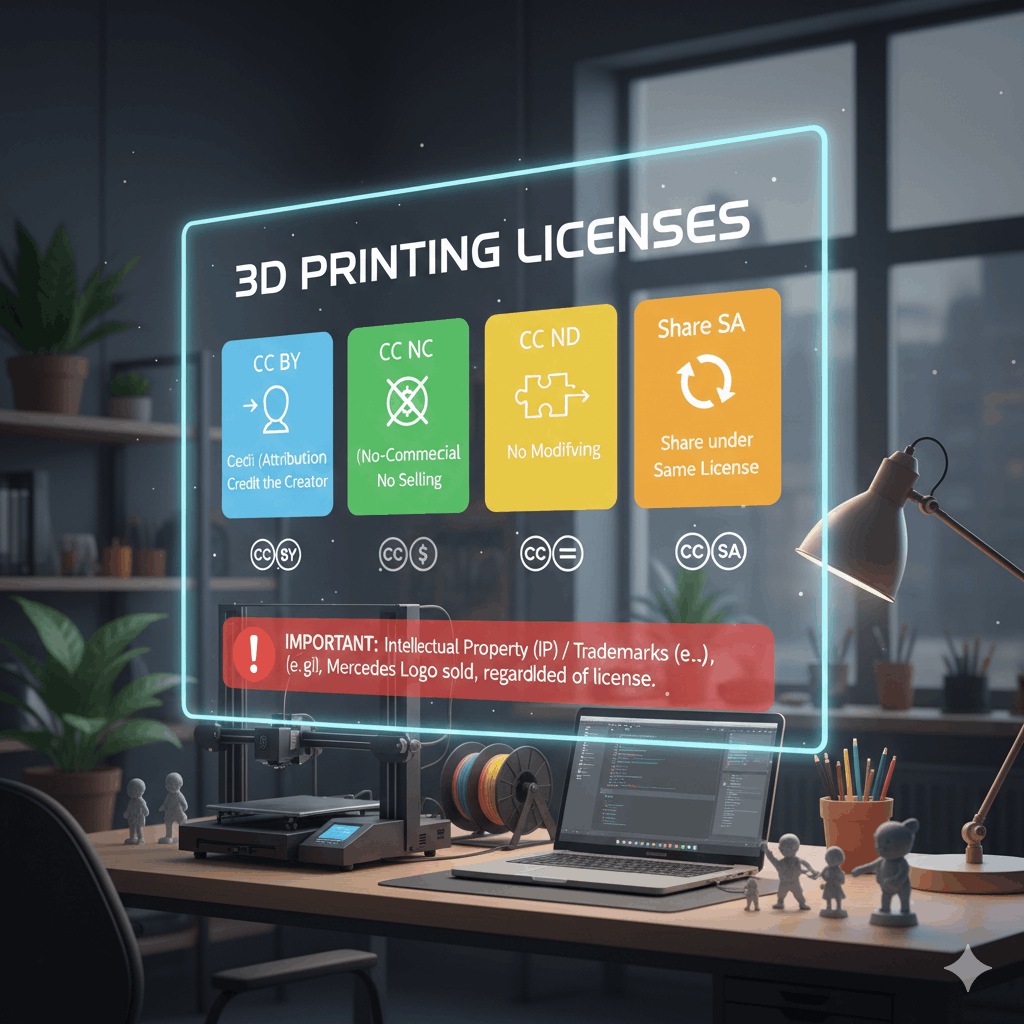
Those small icons you see on 3D model sharing sites are actually legal contracts. Understanding the different types of Creative Commons licenses is essential to avoiding legal action regarding 3D printing licensing.
CC BY (Attribution)
This is the most flexible license. You can download, modify (remix), and even sell the prints. The only requirement is that you must give appropriate credit to the original creator (attribution).
If you modify or “remix” a model and re-upload it, you must distribute your contributions under the same license as the original. You cannot “lock down” a model that was originally shared freely.
CC BY-NC (Non-Commercial)
When you see the “NC” symbol, stop and read carefully. This license indicates that the model is for personal use only. You can print it for yourself or as a gift, but you cannot make money from this model. Selling the physical print or the file is a direct violation.
CC BY-ND (No Derivatives)
The designer is saying, “You can print my model, but you cannot change it.” Cutting the model, merging it with another, or altering the geometry is legally prohibited under this license.
3. Is It Legal to Sell 3D Printed Models?
Many 3D printer owners think, “I have a printer, I can just download files and sell them to make money.” Reality is not that simple. Violating 3D printing licensing can lead to copyright lawsuits and permanent bans from platforms like Etsy, eBay, or Amazon.
How to Acquire Commercial Usage Rights
If you want to sell a design, you should follow these paths:
- Select Commercial-Use Models: Filter your searches on platforms using the “Commercial Use” tag.
- Patreon and Tribes Subscriptions: Today, many professional designers (e.g., Jerrari, STLFlix) offer “Merchant Tiers.” As long as you maintain an active monthly subscription, you have the right to sell their designs.
- Direct Permission: If you find a model you love, email the designer. You can often negotiate a one-time fee or a royalty agreement for sales rights.
4. Fan Art and Trademark Infringement: The Danger Zone
Marvel characters, Disney figures, or famous car brand logos… While printing these for a hobby is generally ignored, the moment you put them up for sale, you may face the legal departments of multi-billion dollar corporations.
Trademark vs. Copyright
While the design of a character falls under copyright, the name and logo fall under trademark law. Companies like Disney are extremely aggressive against “Fan Art” sales. Even if you designed the 3D model of an Iron Man helmet yourself, using the name “Iron Man” to sell it is a trademark violation.
5. The Culture of “Remixing” and Legal Responsibility
The 3D printing community thrives on improving existing models. However, when remixing a model, checking the original license is vital.
- NC (Non-Commercial) remains NC: If you modify a model that was originally “Non-Commercial,” your new version is still legally non-commercial.
- Never Remove Attributions: Deleting the original designer’s name from a file is both unethical and a violation of the “BY” (Attribution) clause.
6. Digital Piracy and Ethical Dimensions
Purchasing a “Premium” STL file and then sharing it in Telegram groups or forums is digital theft. This doesn’t just hurt the designer; it discourages the entire community from producing high-quality content.
Digital Rights Management (DRM)
Some platforms have begun using digital watermarking. A code embedded within the file can prove that a specific copy belongs to you. If that file is leaked, it can be traced back to your account, providing evidence for legal action.
7. 3D Printing and Licensing for Businesses
If you are an engineering firm or provide 3D printing services for offices, you must document the licenses of the parts you produce. Corporate-level infringements carry much higher statutory damages than individual hobbyist errors.
- Open Source Hardware: Some machine parts are entirely open-source. While you can usually print and sell these, you must read the specific license text (GPL, MIT, etc.) to ensure compliance.
FAQ: Frequently Asked Questions About 3D Printing Licensing
Q: Can I paint a free model and sell it? A: If the license contains the “Non-Commercial” (NC) tag, no. Painting or post-processing does not change the legal status of the geometry.
Q: I can’t reach the designer, what should I do? A: If the designer is unreachable and the license does not explicitly allow commercial use, you should not sell the model. “No response” is not “Yes.”
Q: I drew the STL myself, but it has a BMW logo on it. Can I sell it? A: No. Creating the drawing yourself does not give you the right to use BMW’s trademarked logo for profit.
Conclusion
While 3D printing offers limitless creative freedom, that freedom is only sustainable if we respect the hard work and rights of others. Mastering 3D printing licensing not only protects you from legal headaches but also helps you build a reputable brand within the maker community. Remember: the safest path to a successful 3D printing business is creating your own designs or working with models where you officially hold the commercial rights.
Traffic Boosting Tip: Once published, share this guide in “How can I sell this?” threads on Reddit or Facebook groups. Providing a specific solution to a common legal question is a great way to drive high-authority traffic to your site.