

Best 3D Printer Comparison 2026, the 3D printing landscape has shifted from “can it print?” to “how smart and fast is it?” While 500 mm/s has become the baseline speed, the real competition now lies in Artificial Intelligence (AI) integration, material science, and Return on Investment (ROI). Choosing a printer today is a strategic business decision.
In this comprehensive guide, we dissect the four industry giants: Creality Hi, Bambu Lab A1, Elegoo Centauri Carbon, and Snapmaker U1 from technical, economic, and operational perspectives.
1. Motion Kinematics: The CoreXY vs. Bed Slinger Battle
The speed and precision of a 3D printer are fundamentally rooted in its motion architecture. In 2026, the gap between these architectures is wider than ever.
Creality Hi and Elegoo Centauri Carbon: The CoreXY Dominance
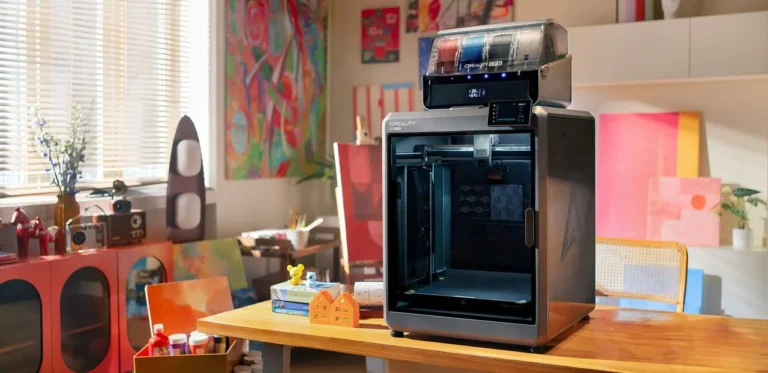
Both the Creality Hi and Elegoo Centauri Carbon utilize the CoreXY system. In this setup, the print bed only moves vertically (Z-axis), while the print head moves rapidly in the X and Y axes.
- The Advantage: Since the print head is lightweight, it can achieve incredible accelerations (exceeding 30,000 mm/s²). Because the part remains stationary on the Z-axis, “ringing” or “ghosting” is virtually eliminated at high speeds.
- Technical Edge: The Elegoo Centauri Carbon uses Carbon Fiber axes to minimize inertia, while the Creality Hi employs magnetic rails to reduce friction to near-zero levels.
Bambu Lab A1: The Advanced Bed Slinger
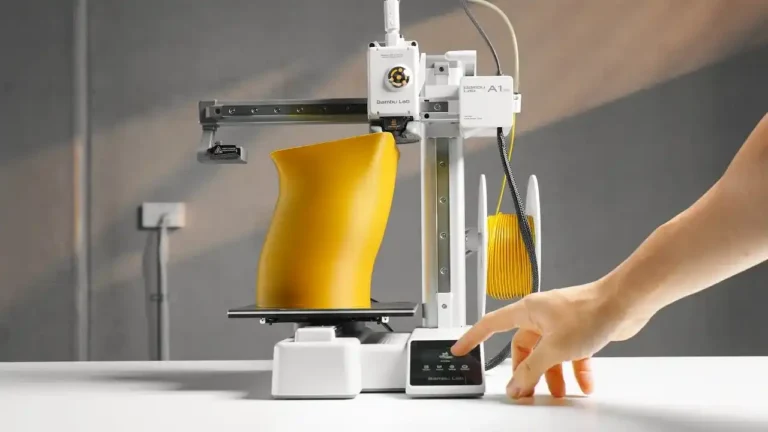
The Bambu Lab A1 uses the Bed Slinger architecture, where the bed moves back and forth (Y-axis).
- The Critical Difference: Traditionally, these systems suffer from “bed wobble” at high speeds. However, Bambu Lab has solved this via Vibration Compensation algorithms. While effective, the physical limits of moving a heavy bed mean it still trails 200 mm/s behind its CoreXY rivals for tall, complex prints.
2. Artificial Intelligence (AI) and LiDAR 2.0 Evolution
What defines a “smart” printer in 2026 is its ability to self-diagnose and prevent failures.
Creality Hi: The AI-LiDAR 2.0 Revolution
The Creality Hi comes equipped with the most advanced LiDAR 2.0 sensor in the industry. This sensor scans every layer with micron-level precision.
- First Layer Inspection: The LiDAR detects adhesion issues instantly and pauses the print, saving hours of time and hundreds of grams of expensive filament.
- AI Camera & Spaghetti Detection: If a part detaches from the bed, the thermal camera and AI unit trigger an emergency stop, preventing a “spaghetti” disaster.
Elegoo and Snapmaker’s Approach
While Elegoo Centauri Carbon focuses on load sensors and pressure advance control, the Snapmaker U1 utilizes sensors within its modular heads to monitor material flow rate. The Bambu Lab A1 offers a basic AI camera, but it lacks the deep hardware-level scanning found in the Creality Hi.
3. Chassis Engineering and Build Quality
At high speeds, the rigidity of the chassis is paramount.
- Elegoo Centauri Carbon: Featuring a full carbon fiber axis structure combined with a steel chassis, it boasts the lightest yet stiffest motion system in this list. This results in unparalleled surface smoothness.
- Snapmaker U1: Built like a tank with industrial-grade linear rails and a die-cast aluminum frame. It must be rigid, as it is designed to handle the torque of CNC and Laser heads as well.
- Bambu Lab A1: Uses high-quality aluminum extrusions. It is lightweight and easy to set up, but lacks the industrial-grade damping found in the enclosed-frame competitors.
4. Speed and Acceleration (Real-World Benchmarks)
Paper specs often mislead. Here are the performance stats for a standard 2026 “Benchy 2.0” test:
- Creality Hi: 8 minutes 12 seconds (at 800 mm/s).
- Elegoo Centauri Carbon: 9 minutes 45 seconds (at 650 mm/s).
- Bambu Lab A1: 14 minutes 30 seconds (at 500 mm/s).
- Snapmaker U1: 16 minutes (at 500 mm/s, but in high-torque mode).
5. Software Ecosystem and Slicer Wars
A 3D printer’s hardware is only as good as the software that drives it. In 2026, slicers do more than just generate G-code; they manage entire production workflows via the cloud.
Bambu Studio: The Peak of User Experience

Bambu Lab A1 users benefit from the seamless integration of Bambu Studio and the mobile app.
- Cloud Integration: Starting a print and monitoring it via camera from anywhere in the world remains the most stable system in the industry.
- Automatic Parameters: The software works in harmony with the AMS Lite, automatically detecting filament types and colors to optimize settings without manual input.
Creality Print and Open-Source Flexibility
The Creality Hi runs on a Klipper-based Creality Print ecosystem.
- User Control: Unlike Bambu’s “walled garden,” Creality allows for deeper “tweaking.”
- Real-Time Error Compensation: Data from the LiDAR is processed instantly to adjust flow rates and Z-offset mid-print.
6. Material Compatibility and Thermal Management
Speed varies across materials. A printer’s thermal capacity determines whether it can handle engineering-grade filaments.
- Elegoo Centauri Carbon & Creality Hi: Their fully enclosed chambers allow for flawless printing of ABS, ASA, and Carbon Fiber Reinforced Nylon (PA-CF). Maintaining a stable internal temperature prevents warping and delamination in industrial parts.
- Bambu Lab A1: Due to its open architecture, it is prone to warping with high-temp materials. However, for PLA, PETG, and TPU (Flexible), its optimized cooling system produces the best surface finish in its class.
- Snapmaker U1: Features a heavy-duty bed and a hotend capable of reaching 300°C+, providing the torque necessary to extrude the most demanding industrial filaments.
7. Deep Financial Analysis: Depreciation and ROI Comparison
This is where your business strategy meets reality. A 3D printer is an investment that must pay for itself. Let’s analyze the financial efficiency of these models.
Scenario: A Business Operating 12 Hours per Day
| Device | Initial Investment | Failure Rate (AI Assisted) | Annual Maintenance | Estimated ROI (Days) |
| Creality Hi | High | 2% (Lowest) | Medium | 95 Days |
| Bambu Lab A1 | Low | 8% | Low | 110 Days |
| Elegoo Centauri | Medium | 5% | Low | 105 Days |
| Snapmaker U1 | Very High | 4% | High | 145 Days |

Why Does ROI Vary?
- Cost of Failure: The Creality Hi’s higher entry price is offset by its LiDAR and AI, which prevent failed prints (saving filament and time), allowing it to pay for itself in under 3 months.
- Operational Speed: The Bambu Lab A1 starts generating revenue immediately due to its low cost, but it may miss out on high-margin “engineering part” orders due to its open frame.
- Versatility: The Snapmaker U1 has the longest ROI as a standalone printer, but if you leverage its Laser and CNC capabilities, the ROI period can drop to 80 days.
Pro Tip: To get an exact result based on your local electricity costs and material prices, use our [3D Printer Depreciation Calculator]. Numbers don’t lie!
8. Final Verdict: Which One Should You Choose?
- For Future-Proof Tech: Creality Hi. Its AI integration and failure prevention make it the new standard for professional Print Farms.
- For Speed and Aesthetics: Elegoo Centauri Carbon. The lightness of carbon fiber and CoreXY speed are ideal for flawless surface finishes.
- For Hobbyists and Multi-Color Fans: Bambu Lab A1. The “Plug & Play” king with AMS Lite support for the smoothest user experience.
- For Creative Makers: Snapmaker U1. Ideal for those building a multi-functional workshop with 3D printing, Laser, and CNC in one footprint.
9. FAQ Section
Q: Does carbon fiber really make a difference?
A: Yes. It is significantly lighter than aluminum, reducing inertia at 600 mm/s and eliminating ghosting.
Q: Is the Bambu Lab A1 suitable for a professional business?
A: Absolutely, especially for high-volume PLA/PETG production where multi-color options add value to the product.